
Dry Rot Treatment in Wickford
Where damp and timber deterioration are found together in Wickford, the source of moisture is an important part of the investigation. Understanding how water is entering or remaining in the building helps shape the right remedial sequence.
Trace the source of moisture and assess the affected timber
Wickford’s local neighbourhood planning work describes a town that has developed with a wide range of building types, materials and designs, alongside concern for the historic features that remain. That variety makes it especially important not to assume a standard construction detail or a single cause of damp. We trace the moisture pattern at the property, examine the affected timber and adjoining materials, then plan any opening-up or repair around the evidence found.
For a Wickford property, the inspection follows the pattern of moisture and timber deterioration to understand whether the issue is confined to one room or connected to adjoining areas.
If dry rot is not established, the next steps should address the actual evidence, which may involve checking for leaks, water penetration, condensation or another form of timber decay.
Moisture investigation: how the findings shape the work
Wickford recommendations take account of the property layout, the type of decay identified and the areas requiring work.
Examine the affected areas
Review visible damage and the condition of accessible timber.
Review building conditions
Investigate possible moisture sources and surrounding building defects.
Define the next steps
Specify suitable remedial measures where dry rot is identified.
Address damaged timber
Repair or replace timber where its condition and function require it.
Our wider services include moisture investigation and timber preservation.
What changes in timber may mean in Wickford
Surface changes in the wood
Timber changes in Wickford should be checked against the surrounding moisture conditions and the role of the affected member.
Signs that may indicate fungal activity
For Wickford properties, the inspection compares any fungal-looking growth with the timber condition and moisture readings; this helps distinguish active decay from surface growth unrelated to dry rot.
Water ingress or slow drying
For properties in Wickford, the investigation also considers how water may be entering or remaining in the building, including leaks, external defects and restricted ventilation.
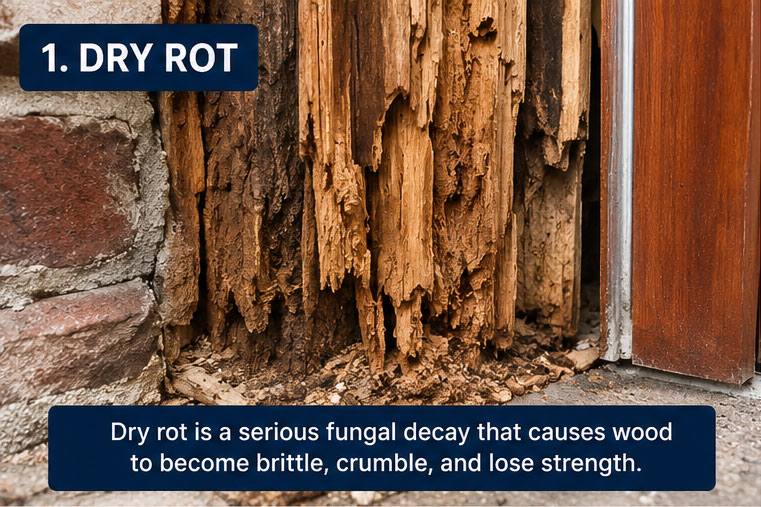
Examples of timber damage and remedial work in Wickford
In Wickford, the condition shown should be compared with the affected timber, nearby materials and moisture history before a repair specification is chosen.
More information: dry rot surveys, dry rot treatment and timber repairs.
Dry rot support in Wickford and surrounding areas
We cover Wickford and nearby communities including Rayleigh, Billericay, Canvey Island and Basildon. Advice is based on the property itself, with its age, construction and condition taken into account.
Browse all Essex areas covered.
Frequently asked questions
Could wet rot be mistaken for dry rot in Wickford?
It is possible because some signs can look alike. A diagnosis should be based on the affected timber and building conditions rather than appearance alone.
What happens if moisture is still affecting timber in a Wickford home?
Any ongoing moisture issue needs to be considered alongside timber treatment. The inspection should explain whether the source is known, what needs correcting and whether additional checks are required.
Will timber treatment solve a leak in a Wickford property?
No. Timber treatment does not repair a leaking pipe or building defect. Any source of moisture needs to be identified and addressed as part of the wider remedial plan.
Arrange advice about dry rot in Wickford
Contact Dry Rot Essex to discuss the symptoms and arrange an assessment.
07379 221549 · info@dryrotessex.co.uk