
Call Us Today07379 221549
Email Usinfo@dryrotessex.co.uk
Areas We CoverAll Essex Areas
Get A Free Quote
Email Usinfo@dryrotessex.co.uk
Areas We CoverAll Essex Areas
Get A Free Quote
⌖Covering All Essex Areas
Dry rot treatment in Tiptree should begin by investigating both the damaged timber and the moisture conditions that allowed fungal growth. A careful survey also checks nearby timber, concealed spaces and likely sources of water ingress. In Tiptree, the right remedial approach depends on the location of the decay and the source of damp. A dry rot survey in Essex can help record the extent of the damage and inform suitable repairs. Excess moisture can create the conditions for fungal growth, so the cause should be investigated before treatment is specified. Homes and commercial buildings in Tiptree can be affected by dry rot where there are leaking roofs, damaged gutters, plumbing faults, penetrating damp or inadequate ventilation.
At Dry Rot Essex, we provide professional dry rot treatment in Tiptree, nearby villages and communities towards Kelvedon, Feering, Tolleshunt Knights and Great Totham. Recommendations for Tiptree properties are based on the moisture source, the condition of the timber and the extent of any confirmed decay.
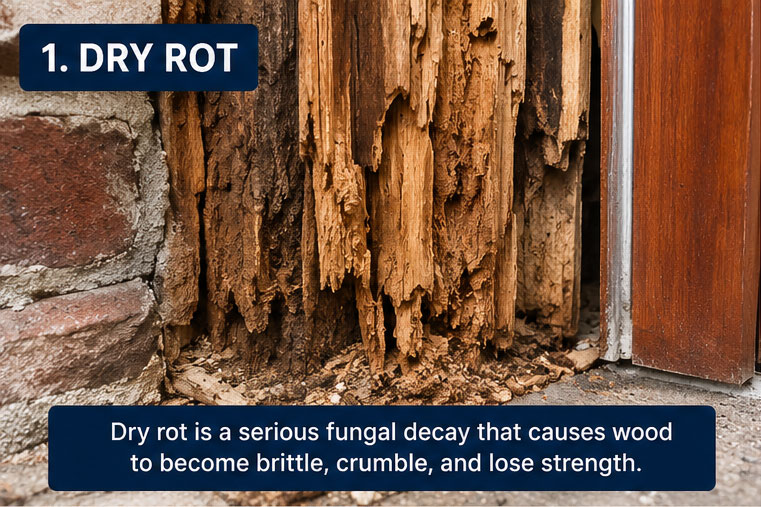
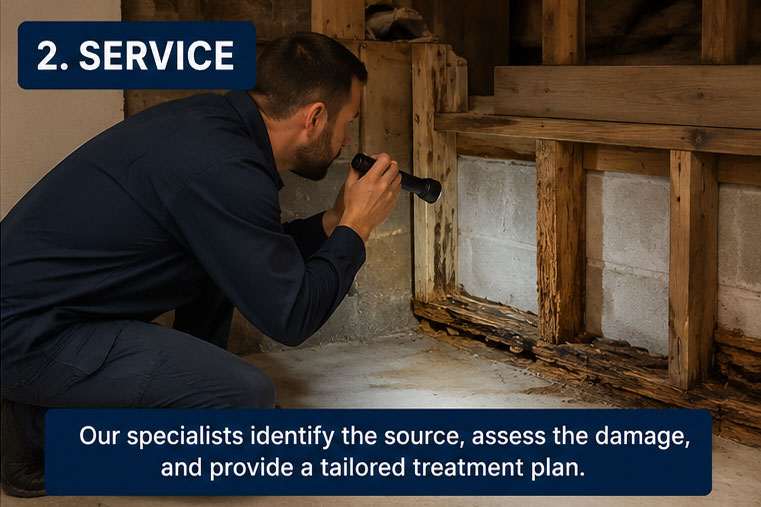
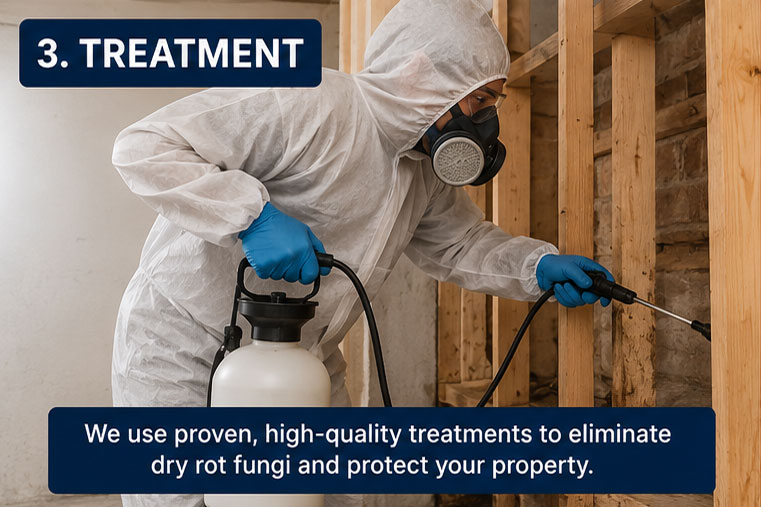

Dry rot requires moisture to develop, despite its name. Once established, fungal decay can affect timber and may spread into adjoining areas when damp conditions remain.
Problems can sometimes be hidden beneath floors, behind wall coverings or within poorly ventilated spaces. This means that visible damage may not always indicate the full extent of the issue.
Our dry rot treatment Tiptree service begins with investigating the property and identifying the conditions that have allowed timber decay to develop.
Knowing what to look for can help property owners identify potential dry rot at an early stage.
Signs may include:
Some dry rot can develop in concealed areas, so unexplained timber damage should always be investigated rather than simply covered or painted over.
A professional survey can help establish whether dry rot is responsible for timber deterioration and identify the areas requiring attention.
During an assessment, attention may be given to floors, joists, skirting boards, roof timbers, wall junctions and other areas where moisture may have become trapped.
A dry rot investigation can help determine:
Correctly identifying the cause is important because different types of timber decay require different treatment approaches.
Treating the visible timber damage alone may not resolve the underlying problem. The source of excess moisture needs to be investigated and, where possible, corrected.
Potential causes include:
Addressing the moisture problem helps create less favourable conditions for continued fungal activity.
The extent of timber damage will determine whether repair or replacement is appropriate.
Dry rot can affect floorboards, joists, skirting boards, wall plates, roof timbers and other wooden components. Where timber has become severely weakened, replacement may be necessary.
However, not every piece of timber showing signs of deterioration necessarily needs to be removed. A proper assessment can help distinguish between timber that can potentially be retained and sections that require remedial work.
The objective is to restore the affected area while addressing the conditions that contributed to the decay.
Tiptree has a mixture of older and newer properties, and different building types can experience different damp and timber problems.
Older properties can be particularly susceptible where there are ageing roof coverings, defective rainwater goods, poor ventilation or historic damp issues. Modern properties can also experience timber decay where leaks, condensation or inadequate ventilation create persistent moisture.
Regular inspection and maintenance of roofs, gutters, plumbing, external walls and ventilation can help reduce the likelihood of moisture-related timber problems developing.
We provide professional dry rot treatment in Tiptree and surrounding areas of Essex, helping homeowners, landlords and property owners identify fungal decay, assess timber damage and prevent dry rot from causing further deterioration.
Our dry rot specialists cover Tiptree and a wide range of nearby Essex towns, villages and residential areas, including:
Billericay | Brentwood | Buckhurst Hill | Burnham-on-Crouch | Canvey Island | Chalkwell | Chelmsford | Coggeshall | Danbury | Earls Colne | Great Dunmow | Hadleigh | Halstead | Hockley | Ingatestone | Kelvedon Hatch | Lamarsh | Leigh-on-Sea | Maldon | Marks Tey | Rainham | Rayleigh | Rochford | South Benfleet | South Woodham Ferrers | Southend-on-Sea | Tiptree | Westcliff-on-Sea | Wickford | Witham
We also cover surrounding Tiptree villages, communities and residential areas across Essex. If you have noticed weakened timber, fungal growth, cracking wood, a musty smell or other possible signs of dry rot, an early inspection can help identify the problem before further timber damage occurs.
Our services include dry rot inspections, diagnosis, treatment and timber remedial work. We assess the affected areas and recommend an appropriate solution based on the extent of the fungal decay and the condition of the timber.
If your location is not listed above, please contact us to check whether we cover your area.
Need dry rot treatment in Tiptree? Contact us today to arrange a professional assessment of your property.
Ignoring signs of dry rot can allow timber deterioration to progress, particularly where the source of moisture remains unresolved.
Early investigation can help establish:
Getting professional advice early can potentially reduce the extent of remedial work required.
If you have discovered damaged timber, fungal growth, a persistent musty smell or unexplained dampness in your Tiptree property, don’t ignore the warning signs.
Dry Rot Essex provides professional dry rot treatment and timber decay services in Tiptree and surrounding Essex locations.
Contact us to discuss your concerns and arrange an assessment of your property.
Dry rot develops when timber becomes sufficiently damp to support fungal growth. Roof leaks, plumbing problems, penetrating damp, condensation and poor ventilation can all contribute.
Early warning signs can include a musty smell, timber discolouration, cracking, shrinking or deterioration. Fungal strands or growth may also become visible.
Yes. Where suitable damp conditions remain, dry rot can spread from an affected area into adjoining timber and other parts of a building.
No. The amount of timber requiring replacement depends on the severity and location of the decay. A professional assessment can determine which timber is seriously affected.
Dry rot can return if the underlying moisture problem is not properly resolved. Identifying and addressing the source of damp is therefore an important part of the treatment process.
Yes. Dry Rot Essex provides dry rot treatment and timber decay services for properties throughout Tiptree and the surrounding Essex area.