
7 Early Signs of Dry Rot in Your Essex Home – What to Look For
Dry rot is one of the more serious forms of timber decay that can affect houses and other buildings. It develops when timber becomes damp and remains in conditions that allow fungal growth to establish. Once active, dry rot can damage timber and spread beyond the original area of moisture, potentially affecting floors, joists, skirting boards, roof timbers and other structural woodwork.
The good news is that recognising the warning signs early can help prevent a relatively small problem from becoming a much larger repair project.
If you own a property in Essex and have noticed unusual smells, damaged timber or fungal growth, here are 7 signs of dry rot to look out for.
1. A Strong Damp or Musty Smell
One of the first things homeowners may notice is an unusual musty or mushroom-like smell.
Dry rot can develop in concealed areas such as beneath floors, behind skirting boards, inside wall cavities and around damp timber. This means you may notice an odour before you can actually see the affected wood.
A persistent damp smell does not automatically mean you have dry rot. Other problems, including condensation, penetrating damp, leaks and wet rot, can also produce unpleasant odours.
However, if the smell is accompanied by damaged timber or fungal growth, it is sensible to arrange a professional inspection.
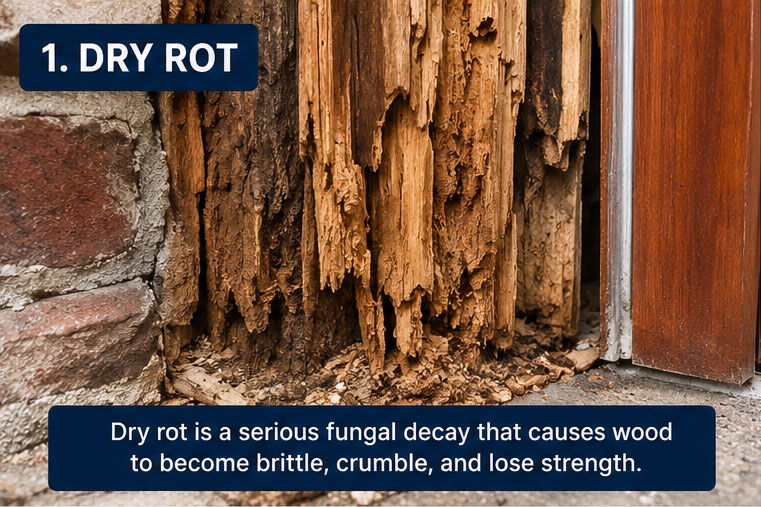
2. Timber Starts to Shrink, Crack or Become Brittle
Dry rot can significantly change the appearance and condition of timber.
Affected wood may become:
- Darker or discoloured
- Dry and brittle
- Shrunken
- Cracked into roughly square or cubical sections
- Weak or crumbly
- Distorted or damaged
The characteristic cracking and shrinkage associated with dry rot can be an important warning sign. Professional guidance from the Property Care Association identifies shrinking timber and deep cross-cracking as characteristic features of dry rot damage.
If timber that should be solid suddenly feels weak or breaks unusually easily, it should not simply be painted over or covered up.
3. Fine Brown or Rust-Coloured Dust Appears
Another possible warning sign is the appearance of fine orange, brown or rust-coloured dust.
This can be associated with dry rot spores and may accumulate on horizontal surfaces beneath or near fungal growth.
You might notice the dust:
- On floors
- On window ledges
- Around skirting boards
- Beneath affected timber
- On shelving or other nearby surfaces
The presence of a small amount of dust does not prove that dry rot is active, but larger areas of rust-coloured spore dust should be investigated, particularly when combined with other symptoms.
4. Grey, White or Cotton-Wool-Like Fungal Growth
Dry rot can produce visible fungal growth on timber and surrounding surfaces.
Depending on the conditions, this may look like:
- Fine grey strands
- White cotton-wool-like growth
- Silky fungal material
- Web-like strands extending from timber
- Larger patches of fungal growth
These fungal strands are particularly important because dry rot can extend beyond the timber it is feeding on. The fungus can grow across masonry and through concealed spaces in search of additional timber.
This is one reason why simply replacing a visibly damaged piece of wood may not resolve the underlying problem.
5. Mushroom-Like Fruiting Bodies
In more established cases, dry rot can produce distinctive fruiting bodies.
These may appear as pancake-shaped or bracket-like growths, often with lighter edges and orange, reddish or brown colouring.
The appearance of a fruiting body is a significant warning sign because it indicates that fungal growth has become established.
Property Care Association guidance describes dry rot fruiting bodies as a characteristic feature of Serpula lacrymans, the fungus responsible for true dry rot.
If you discover mushroom-like growth emerging from a wall, floor, skirting board or timber structure, do not assume it is harmless simply because it appears small.
6. Floors or Timber Feel Weak or Springy
Dry rot does not always announce itself with an obvious fungus.
In some properties, the first noticeable problem may be structural.
A floor that suddenly feels:
- Springy
- Uneven
- Soft
- Unstable
- Different underfoot
could indicate deterioration of the timber beneath it.
This is particularly important around suspended timber floors, joists and areas where timber is built into damp walls.
The visible floor covering may look perfectly normal while the timber underneath has been affected.
7. There Is Dampness Near Timber
Perhaps the most important warning sign is the presence of a moisture problem.
Despite its name, dry rot does not develop in genuinely dry conditions. Serpula lacrymans requires damp timber and suitable environmental conditions to establish and grow. Professional guidance stresses that identifying and resolving the source of moisture is a fundamental part of successful treatment.
Potential sources of moisture can include:
- Leaking pipes
- Roof leaks
- Defective gutters or downpipes
- Penetrating damp
- Rising damp
- Poor ventilation
- Moisture trapped beneath floors
- Damp masonry
- Condensation
- Water entering around windows or doors
Finding the moisture source is therefore just as important as identifying the damaged timber.
Where Is Dry Rot Commonly Found?
Dry rot can occur in many parts of a property, particularly where timber is exposed to persistent moisture or poor ventilation.
Common areas include:
Suspended Timber Floors
Joists and floorboards can be vulnerable where moisture enters from damp ground, walls or poorly ventilated sub-floor areas.
Skirting Boards
Skirting boards can become affected where they are in contact with damp masonry or where moisture is trapped behind them.
Roof Timbers
Roof leaks can introduce moisture into rafters and other timber components. A small leak that remains unnoticed can create favourable conditions for fungal decay.
Timber Built Into Walls
Timbers embedded within damp masonry can be particularly difficult to inspect. Dry rot may spread from affected timber into surrounding areas.
Cellars and Sub-Floor Areas
Poor ventilation combined with moisture can create conditions suitable for fungal decay, particularly in enclosed or rarely accessed areas.
Can Dry Rot Spread?
Yes. One of the reasons dry rot needs to be taken seriously is its ability to extend beyond the original area of affected timber.
The Property Care Association explains that Serpula lacrymans can spread through buildings via fungal growth over masonry and into concealed areas in search of suitable timber.
This means the location where you first notice the problem may not be the location where it started.
For example, fungal growth appearing around a skirting board could potentially be connected to damp timber beneath a floor or within a wall.
That is why professional investigation is important before deciding what needs to be repaired or replaced.
Is It Dry Rot or Wet Rot?
Dry rot and wet rot are different forms of timber decay and should not automatically be treated in the same way.
Wet rot is generally associated with timber that remains excessively wet, with decay tending to remain closer to the area of moisture.
True dry rot is caused by Serpula lacrymans and has the ability to spread through a building beyond the immediately wet timber.
Because different types of timber decay can look similar, identifying the problem correctly is an important first step.
What Should You Do If You Suspect Dry Rot?
If you notice one or more of the warning signs above, avoid simply covering the affected area with paint, flooring or new timber.
The first step should be to establish:
- Whether dry rot is actually present
- Where the affected timber is located
- How extensive the decay is
- What caused the moisture problem
- Whether nearby timber has also been affected
- What repairs are required
A professional dry rot survey can help establish the extent of the problem and identify the likely source of moisture.
The Property Care Association recommends that suspected dry rot is investigated by a specialist because the cause of water ingress and the full extent of damage need to be established before an appropriate remedial strategy can be determined.
Why Fixing the Moisture Source Matters
One of the biggest mistakes with timber decay is concentrating solely on the damaged wood.
Removing rotten timber without dealing with the reason it became damp can allow the underlying conditions to remain.
Historic England also advises that the source of damp should be addressed when dealing with timber rot because replacing timber or applying treatment without resolving the moisture problem can result in the issue recurring.
Effective remedial work therefore needs to consider the building as a whole.
Professional Dry Rot Treatment in Essex
If you have noticed damaged timber, fungal growth, unusual smells, rust-coloured dust or unexplained dampness, Dry Rot Essex can investigate the problem and advise on the appropriate next steps.
Our services include dry rot surveys, dry rot treatment, timber repairs, timber preservation and moisture investigations for properties throughout Essex.
We work with homeowners, landlords, property developers, estate agents, businesses and other property professionals.
If dry rot is suspected, an early inspection can help establish the extent of the problem before further timber becomes affected.
Call Dry Rot Essex on 07379 221549 to discuss your property or arrange a dry rot survey.
Frequently Asked Questions
Can dry rot start because of a leaking pipe?
Yes. A leaking pipe can introduce moisture into timber or surrounding building materials. If the timber remains damp and other conditions are suitable, fungal decay can develop.
Does dry rot always have a visible fungus?
No. Dry rot can develop in concealed locations, so visible fungal growth is not always present. Damaged timber, unusual smells and unexplained moisture can also be warning signs.
Can dry rot spread through brickwork?
Yes. True dry rot can extend across masonry and concealed building spaces in search of suitable timber.
Is dry rot the same as wet rot?
No. Dry rot and wet rot are different forms of fungal timber decay. Correct identification is important because the extent and treatment requirements can differ.
Should I replace rotten timber immediately?
Not necessarily. The cause and extent of the decay should first be established. Treatment and repairs should be based on the condition of the timber and the underlying moisture problem.
Can dry rot come back after treatment?
It can if the conditions that allowed the fungal growth to develop are not properly addressed. Controlling the moisture source is therefore a fundamental part of long-term remedial work.
Suspect Dry Rot in Your Essex Property?
Don’t ignore unusual smells, damaged timber or unexplained fungal growth. Early investigation can help establish the cause and prevent a localised timber problem from developing into more extensive damage.
Dry Rot Essex provides professional dry rot surveys, treatment and timber repairs throughout Essex.
Telephone: 07379 221549