
7 Signs of Woodworm in Your Home – How to Identify an Active Infestation
Woodworm is a common term used to describe damage caused by the larvae of wood-boring beetles. These insects can affect timber in houses, flats, commercial buildings and other properties, potentially causing significant damage if an infestation remains untreated for a long period.
One of the difficulties with woodworm is that much of the damage can occur inside the timber. By the time obvious signs become visible, the larvae may have already been active for some time.
If you own a property in Essex, knowing the warning signs can help you identify a potential problem early.
Here are 7 signs of woodworm to look for in your property.
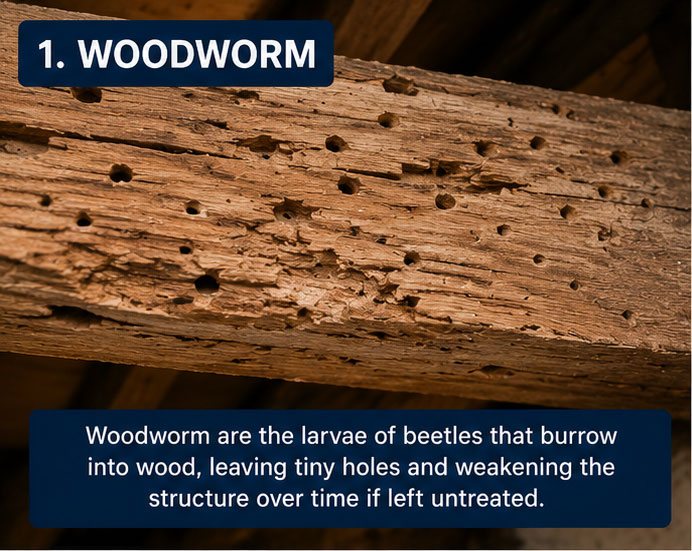
1. Small Holes in Wooden Surfaces
One of the most recognisable signs of woodworm is the appearance of small holes in timber.
These are commonly referred to as exit holes. Adult wood-boring beetles can emerge from timber after developing inside the wood, leaving small holes behind.
You may find holes in:
- Floorboards
- Joists
- Roof timbers
- Skirting boards
- Doors
- Wooden furniture
- Staircases
- Timber beams
- Other structural woodwork
The size and appearance of the holes can vary depending on the species of beetle involved.
However, the presence of holes alone does not necessarily mean that an infestation is currently active.
2. Fresh Bore Dust or Frass
Another important warning sign is the appearance of fine dust around timber.
This material is often referred to as frass or bore dust and can be produced when wood-boring insects tunnel through timber.
You might notice small piles of dust:
- Beneath wooden beams
- Around floorboards
- Near skirting boards
- Inside cupboards
- Around roof timbers
- On window ledges
- Beneath affected furniture
Fresh-looking bore dust can indicate recent insect activity, particularly if it reappears after the area has been cleaned.
However, bore dust can also be disturbed or moved from older damage, so professional inspection may be necessary to establish whether an infestation is active.
3. Damaged or Weakened Timber
Woodworm larvae feed within timber and can create tunnels through the wood.
Over time, extensive tunnelling can reduce the strength and integrity of affected timber.
Look for timber that appears:
- Crumbly
- Weak
- Damaged
- Hollow
- Uneven
- Heavily perforated
Structural timber deserves particular attention. Joists, roof timbers and beams can perform important load-bearing functions, so significant deterioration should not be ignored.
4. Beetles Around the Property
Adult wood-boring beetles may sometimes be found near affected timber.
Although spotting a beetle does not automatically prove that your property has an active infestation, finding insects alongside fresh bore dust and new exit holes can provide useful evidence.
If you find an unfamiliar beetle near damaged timber, avoid throwing it away if possible. A pest or timber specialist may be able to identify the species and assess whether it is associated with the damage.
5. New Holes Keep Appearing
Old woodworm holes can remain visible for many years after an infestation has ended.
This is why simply counting holes is not enough to determine whether treatment is required.
A more significant warning sign is new activity.
For example, you may notice that:
- New holes are appearing
- Fresh dust is accumulating
- Previously clean timber is becoming damaged
- The amount of bore dust increases
- Activity is appearing in different areas
These signs can suggest that beetle activity is ongoing.
6. Timber Has Extensive Tunnelling
Much of the damage caused by woodworm can occur beneath the surface of the timber.
Larvae can tunnel through wood while feeding and developing. In severe cases, this can leave timber with a network of internal tunnels.
The outside of the wood may initially look relatively normal while the inside has suffered considerable deterioration.
This is particularly important in older properties where timber may have been exposed to suitable conditions for wood-boring insects over many years.
7. Damp Timber or Poorly Ventilated Areas
Moisture and the condition of timber can influence the likelihood and severity of some wood-boring insect problems.
Areas with poor ventilation or damp conditions can be particularly important when investigating timber decay and insect attack.
Potential problem areas can include:
- Suspended timber floors
- Cellars
- Roof spaces
- Damp walls
- Poorly ventilated sub-floor areas
- Timber close to sources of moisture
If woodworm is suspected alongside damp or timber decay, it is important to investigate the wider condition of the building rather than treating the insect damage in isolation.
Does Every Hole Mean You Have Active Woodworm?
No.
This is an important distinction for homeowners.
Woodworm holes can remain visible in timber long after the insects have left. Therefore, seeing old holes does not automatically mean that treatment is necessary.
A professional assessment looks at several factors, including:
- The appearance of the holes
- The condition of the timber
- The presence of fresh bore dust
- Signs of recent insect activity
- The type of timber affected
- Moisture and environmental conditions
- The location and extent of the damage
The objective is to determine whether the infestation appears active and whether the timber has suffered significant deterioration.
Can Woodworm Damage Structural Timber?
Yes, depending on the extent of the infestation and the timber involved.
Not every woodworm infestation causes serious structural damage. However, prolonged or extensive insect attack can reduce the cross-section and strength of timber.
This is particularly relevant where insects have affected:
- Floor joists
- Roof timbers
- Beams
- Rafters
- Structural supports
If you are concerned about structural timber, it is better to have the condition assessed rather than assuming the damage is cosmetic.
Common Areas to Check for Woodworm
Wood-boring insects can affect many different timber components around a property.
Loft and Roof Spaces
Roof timbers can sometimes be overlooked because loft spaces are not regularly accessed.
Check rafters, beams and other exposed timber for holes, dust and signs of deterioration.
Suspended Floors
Floorboards and joists can be affected, particularly in older properties.
Pay attention to unusual movement, damaged timber and signs of bore dust.
Skirting Boards
Skirting boards are easy to inspect and can sometimes reveal signs of historic or active insect activity.
Staircases
Timber staircases can contain numerous wooden components that may be affected by wood-boring insects.
Older Timber Features
Beams, panelling, doors and other original timber features can also be susceptible depending on their condition and environment.
Woodworm and Damp Problems
Woodworm should not always be considered a completely separate issue from damp.
The condition of timber and the moisture environment within a building can influence timber decay and insect activity.
If you discover woodworm alongside damp timber, mould, wet rot or dry rot, it may be necessary to investigate the underlying moisture problem as part of the overall assessment.
Treating one symptom without addressing the conditions contributing to timber deterioration may not provide a long-term solution.
Should You Treat Woodworm Yourself?
There are DIY woodworm products available, but choosing the correct treatment requires an understanding of the type and extent of the problem.
Before applying treatment, it is important to establish:
- Whether the infestation is active
- What type of beetle may be involved
- Which timber has been affected
- How extensive the damage is
- Whether structural timber is involved
- Whether damp or other building defects are contributing to the problem
Applying a product without properly identifying the problem can result in unnecessary treatment or leave an underlying issue unresolved.
For significant infestations, particularly where structural timber may be involved, a professional survey is advisable.
Professional Woodworm Surveys and Treatment in Essex
If you have discovered small holes, fresh bore dust, damaged timber or other signs of woodworm, Dry Rot Essex can assess the problem and advise on the appropriate next steps.
We provide woodworm surveys, woodworm treatment and timber preservation services throughout Essex.
A professional inspection can help establish whether the evidence indicates an active infestation, identify affected areas and determine whether treatment or timber repairs are required.
Early investigation can be particularly useful where woodworm is discovered in structural timber or alongside damp and other forms of timber decay.
Suspect woodworm in your Essex property? Contact Dry Rot Essex on 07379 221549 to discuss your requirements.
Frequently Asked Questions
What are the main signs of woodworm?
Common signs include small holes in timber, fresh bore dust, damaged or weakened wood, beetles and evidence that new holes are appearing.
Do old woodworm holes mean the infestation is active?
Not necessarily. Exit holes can remain visible long after an infestation has ended. Other evidence, such as fresh bore dust and recent damage, can help establish whether activity is ongoing.
Is woodworm dangerous to a house?
Woodworm does not automatically mean that a property has serious structural problems. However, extensive insect damage can weaken timber, particularly when structural components have been affected.
Can woodworm affect roof timbers?
Yes. Wood-boring insects can affect timber in roof spaces, including rafters and other wooden components.
Can woodworm be treated?
Yes. Depending on the species, extent of the infestation and condition of the timber, professional treatment may be appropriate.
Should I replace timber affected by woodworm?
Not always. Timber replacement depends on the extent of the damage and the structural condition of the wood. A professional assessment can help determine whether treatment, repair or replacement is appropriate.
Does damp cause woodworm?
Damp conditions can be relevant to the condition of timber and some wood-boring insect problems, but the relationship depends on the particular insect species and building conditions. A proper inspection should consider both insect activity and moisture.
Concerned About Woodworm?
Don’t ignore unexplained holes, fresh bore dust or deteriorating timber. Establishing whether an infestation is active and how extensively the timber has been affected can help you decide what needs to be done.
Dry Rot Essex provides professional woodworm surveys and treatment throughout Essex.
Telephone: 07379 221549