
What Does Dry Rot Look Like? Signs to Look For in Your Home
Knowing what dry rot looks like can help property owners recognise potential timber problems before they become more extensive. Dry rot is a fungal form of timber decay that can affect wooden floors, joists, beams, roof timbers, skirting boards, door frames and other timber within a property.
The appearance of dry rot can change as the problem develops, and some signs can be confused with other forms of timber decay. If you have noticed unusual damage to timber in your Essex property, a professional dry rot survey can help establish the cause.
What Does Dry Rot Look Like?
Dry rot can produce several visible and physical changes to timber.
Common signs include:
- Cracked timber
- Shrinking wood
- Brittle or weakened timber
- Deep cracks running across the grain
- Brown or reddish discolouration
- White or grey fungal growth
- Fine fungal strands
- Musty smells
- Fruiting bodies
- Distorted timber
- Timber that breaks away easily
Not every property will display all of these signs.
The appearance can depend on the age of the decay, the type of timber affected and the conditions within the building.
Cracked and Shrunken Timber
One potential sign of dry rot is timber that has developed noticeable cracking.
Affected wood can become brittle and may develop cracks both along and across the grain. In more advanced cases, timber can appear significantly deteriorated or distorted.
If timber that was previously sound has suddenly developed unusual cracking or shrinkage, it is worth investigating the cause.
Timber That Has Become Brittle
Dry rot can significantly affect the condition of timber.
Affected wood may become:
- Brittle
- Dry-looking
- Weak
- Crumbly
- Distorted
- Easy to break or damage
However, timber that appears dry does not necessarily mean that dry rot is present. Other forms of decay, age-related deterioration and previous moisture damage can produce similar symptoms.
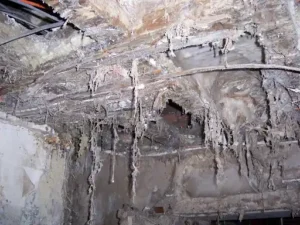
Fungal Growth
Another possible indication is fungal growth on or around affected timber.
Depending on the conditions, fungal growth may appear as fine strands or a more developed fungal mass.
Fungal growth can sometimes be hidden behind:
- Plaster
- Skirting boards
- Flooring
- Wall coverings
- Furniture
- Other building materials
This is one reason why visible signs may not always show the full extent of a timber problem.
Musty Smells
A persistent musty or unusual smell can sometimes accompany damp timber and fungal activity.
A smell alone cannot confirm dry rot, however.
If a musty smell occurs alongside damaged timber, damp conditions or visible fungal growth, it may be worth arranging a professional inspection.
Dry Rot Fruiting Bodies
In some circumstances, dry rot can produce fruiting bodies.
These may appear as raised fungal growths and can eventually produce spores.
Fruiting bodies are not necessarily present in every case, so their absence does not mean that dry rot can be ruled out.
If you discover unusual fungal growth on timber or nearby surfaces, avoid assuming what it is based solely on appearance.
Brown or Discoloured Timber
Affected timber may develop brown, reddish or otherwise unusual discolouration.
Changes in timber colour can have many possible causes, including:
- Moisture
- Fungal decay
- Age
- Previous treatment
- Staining
- Water damage
Consequently, discolouration should be considered alongside other symptoms rather than used as a diagnosis by itself.
Dry Rot Cracking Patterns
Advanced timber decay can produce characteristic cracking patterns.
The timber may develop a cuboidal or block-like cracking appearance as it deteriorates.
This can be an important visual clue, but other forms of timber deterioration can also produce cracking.
A professional assessment is therefore recommended when the condition or cause of timber damage is uncertain.
Can Dry Rot Be Hidden?
Yes. One of the difficulties with timber decay is that the visible damage may not represent the entire affected area.
Dry rot can occur beneath or behind building materials, particularly where moisture has been present for an extended period.
Potential hidden areas include:
- Beneath floorboards
- Behind skirting boards
- Within wall cavities
- Around leaking pipes
- Beneath flooring
- Around roof structures
- Behind wall finishes
- Around poorly ventilated areas
If there is evidence of a persistent moisture problem, inspecting nearby timber can help establish whether deterioration has occurred.
Where Is Dry Rot Commonly Found?
Dry rot can affect timber in many parts of a building.
Floor Joists
Moisture beneath floors can create conditions where timber decay develops.
Floorboards
Damaged floorboards may be an indication of a wider problem within the floor structure.
Roof Timbers
Roof leaks can introduce moisture around rafters, beams and other timber components.
Skirting Boards
Skirting boards can be affected where moisture is entering from walls or floors.
Door Frames
Timber door frames can deteriorate where water penetration or damp conditions are present.
Window Surrounds
Moisture around windows can contribute to timber deterioration, particularly where water ingress or condensation is persistent.
What Causes Dry Rot?
Moisture is an important factor in the development of dry rot.
Potential causes of damp timber include:
- Leaking roofs
- Defective gutters
- Plumbing leaks
- Water ingress
- Poor ventilation
- Condensation
- Damp areas
- Defective drainage
- Moisture entering around windows and doors
Finding the underlying moisture source is an important part of investigating suspected dry rot.
For more information, see our guide:
Dry Rot vs Wet Rot
Dry rot should not be confused with wet rot.
Both conditions can cause timber deterioration, and some symptoms can appear similar. However, they are different types of fungal decay and may require different remedial approaches.
If you cannot determine whether damaged timber has dry rot or wet rot, a professional timber inspection can help establish the likely cause.
Does All Damaged Timber Have Dry Rot?
No.
Timber can become damaged for many reasons, including:
- Wet rot
- Woodworm
- Water damage
- Age
- Poor ventilation
- Structural movement
- Previous leaks
- General deterioration
This is why it is important not to diagnose dry rot from a photograph or a single visual symptom alone.
Why Arrange a Dry Rot Survey?
If you discover damaged timber and are concerned about possible dry rot, a professional survey can help identify:
- What is causing the timber deterioration
- Which areas are affected
- Whether moisture is present
- The possible extent of the problem
- Whether timber repairs may be required
- What remedial work may be appropriate
Early investigation can help property owners understand the condition of their timber and determine what action may be required.
Dry Rot Surveys in Essex
Dry Rot Essex provides professional dry rot surveys and timber inspections across Essex.
We cover locations including:
- Chelmsford
- Colchester
- Southend-on-Sea
- Brentwood
- Billericay
- Maldon
- Rayleigh
- Rochford
- Wickford
- Braintree
- Epping
- Loughton
- Waltham Abbey
- Buckhurst Hill
- Chigwell
- Witham
- Great Dunmow
- South Woodham Ferrers
- Canvey Island
- Hockley
- Tiptree
- Halstead
We also cover surrounding Essex towns and villages.
Frequently Asked Questions
What are the first signs of dry rot?
Potential early warning signs include unusual timber cracking, shrinkage, discolouration, musty smells and changes in the condition of wooden components. These symptoms can have other causes, so inspection may be required.
What colour is dry rot?
Dry rot can cause affected timber to become brownish or reddish and may be accompanied by fungal growth. Colour alone is not enough to confirm dry rot.
Does dry rot look like mould?
Some fungal growth associated with timber decay can look similar to mould, but they are not necessarily the same thing. A professional inspection can help determine what is affecting the property.
Can you see dry rot through paint?
Not necessarily. Timber deterioration can sometimes be hidden beneath paint, flooring, plaster or other building materials.
Does dry rot smell?
A musty smell can sometimes accompany damp timber and fungal activity, although smell alone cannot confirm dry rot.
Can dry rot be hidden?
Yes. Timber decay can develop beneath floors, behind skirting boards, within wall areas and around other concealed timber.
Is cracked timber always dry rot?
No. Cracked timber can have many causes. Dry rot is only one possible explanation for timber cracking or deterioration.
What should I do if I think I have dry rot?
Avoid disturbing potentially affected areas unnecessarily and consider arranging a professional dry rot inspection to establish the cause and extent of the problem.
Suspect Dry Rot?
If you have noticed cracked, weakened or unusual-looking timber in your property, Dry Rot Essex can help investigate the problem.
We provide dry rot surveys, inspections, treatment and timber repairs across Essex.
Call 07379 221549 to discuss your property or arrange a survey.
Dry Rot Essex
1 Woodhouse Lane
Chelmsford
CM1 7EU
Telephone: 07379 221549
Email: info@dryrotessex.co.uk